Clean & Modern: Designing a Digital Banking Interface with PayLink
In the competitive landscape of financial technology, first impressions are not just visual—they are a matter of trust. When a potential customer lands on your website, they are subconsciously asking, "Is my money safe here? Is this service modern? Is this interface easy to use?" If your landing page looks cluttered, outdated, or confusing, you lose that trust in seconds. This is why the aesthetic of your digital presence is as critical as the financial features you offer. A clean, bright, and organized interface is no longer a luxury; it is the baseline for user expectations.
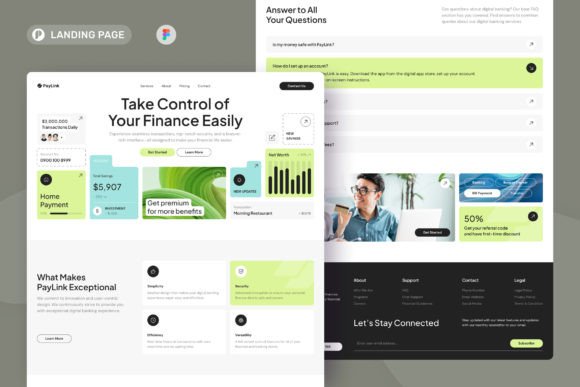
This is precisely where the PayLink - Digital Banking Landing Page Figma template enters the conversation. It is not merely a collection of layers and vectors; it is a carefully constructed visual environment designed to bridge the gap between complex financial services and user-friendly accessibility. The design philosophy behind PayLink focuses on clarity, utilizing a bright aesthetic that eliminates visual noise. For designers, developers, and fintech entrepreneurs, this template offers a foundation that respects the user's time and intelligence, providing a seamless path from curiosity to conversion.
The Psychology of the Green Palette in Fintech
Color theory plays a massive role in how we perceive financial brands. While blue has traditionally been the go-to for banks to represent stability, the shift toward digital-first banking has seen a rise in the use of green. The PayLink - Digital Banking Landing Page makes a strategic choice by incorporating green as its primary accent color. In the context of finance, green universally signals growth, vitality, positive movement, and, of course, money. However, the specific shade and application matter.
PayLink uses green not as a heavy, overwhelming block of color, but as a refreshing highlight against a white or light-grey background. This creates a "bright and clean" atmosphere. For the user, this reduces cognitive load. They aren't bombarded with dark, heavy themes that feel like a vault; instead, they feel invited into a modern ecosystem. This fresh approach helps in branding efforts, allowing a company to appear approachable yet professional. If you are building a brand identity for a savings app, a crypto wallet, or a personal finance tool, this color strategy helps position your service as something that brings positive change to the user's life.
Structuring Information: The Power of Organization
One of the most common pitfalls in landing page design is information overload. Financial services often have to communicate a lot of data—interest rates, security protocols, features, and pricing. The PayLink - Digital Banking Landing Page template solves this through a "well-organized layout." This is where the design moves beyond aesthetics into functional utility.
The layout utilizes a grid system that prioritizes hierarchy. The most important call-to-action (CTA) is given prominence, while secondary information is tucked into digestible sections. For a designer or developer customizing this template, this structure is invaluable. It allows you to tell a story. You can start with a bold value proposition, move into feature breakdowns, display social proof, and end with a compelling offer—all without the user feeling lost. This organization is crucial for web design projects where the goal is to keep the bounce rate low and engagement high. The template essentially acts as a roadmap for user experience (UX), ensuring that the visual flow matches the logical flow of the customer journey.
Practical Versatility: Beyond Digital Banking
While the name suggests a specific niche, the utility of the PayLink - Digital Banking Landing Page extends far beyond traditional banking apps. Because of its modern typography and modular design, it serves as a robust asset for a variety of creative and commercial projects. If you are a small business owner launching a SaaS product, a subscription box service, or a management tool, the clean lines of PayLink provide the professional presentation required to compete in crowded markets.
Consider the adaptability of the template for different contexts:
- Marketing Assets: The sections are easily adaptable to create high-converting sales pages for digital products or editorial layouts for tech blogs.
- Brand Identity: The consistent use of spacing and typography can be extracted and applied to other design assets, such as pitch decks or social media kits, ensuring visual consistency across all platforms.
- Startup Launches: For entrepreneurs, time is money. Using a pre-structured, easy to edit Figma file means you can go from concept to a live prototype in a fraction of the time it would take to design from scratch.
The flexibility of the design means it can handle social media graphics integration or packaging design mockups if you are showcasing a physical product that has a digital component. It is a versatile canvas that supports the visual language of innovation.
Typography and Readability: The Technical Backbone
A landing page is only as good as its readability. If a user has to squint to read the fine print or struggle to decipher a stylized font, the design has failed. The PayLink - Digital Banking Landing Page addresses this by utilizing FREE fonts from Google Fonts. This is a practical choice for several reasons. First, it ensures that the typography is web-optimized and renders correctly across all browsers and devices. Second, it eliminates licensing headaches for the end-user.
The choice of sans serif font styles typically found in such templates contributes to a modern aesthetic. Sans serifs are known for their clean lines and high legibility on digital screens, making them ideal for UI elements, buttons, and body text. When customizing the template, it is important to respect the typographic hierarchy established by the designer. Using a bold weight for headlines and a lighter weight for body copy helps guide the eye naturally. This attention to readability ensures that your message is communicated clearly, which is essential for building brand recognition and trust.
Customization and Workflow Efficiency
For the creative professional, the technical specifications of a template are just as important as the visual ones. The PayLink - Digital Banking Landing Page is built for Figma, the industry-standard tool for collaborative interface design. The fact that it is well documented and easy to edit and customize means that the handoff from design to development is smooth.
The template features a 1440px width, which is a standard desktop resolution, ensuring that your design looks great on the majority of monitors. Furthermore, the inclusion of re-sizeable and editable graphics is a significant time-saver. You aren't stuck with rasterized images that pixelate when you try to change the size. Instead, you have vector-based assets that can be manipulated to fit your specific logo design or iconography needs.
When working with the file, consider the following workflow tips to maximize efficiency:
- Global Styles: Immediately update the color styles and text styles to match your brand guidelines. This will automatically update elements across the entire page, maintaining visual consistency.
- Componentization: Look for repeated elements like buttons or cards and turn them into Figma components. This allows for rapid prototyping and easy updates later in the project.
- Responsive Planning: While the template is set at 1440px, use Figma’s constraints and auto-layout features to plan how the design will collapse for tablet and mobile views.
Final Thoughts on Design Quality
In a digital world saturated with generic templates, the PayLink - Digital Banking Landing Page stands out by offering a balance of aesthetic appeal and structural integrity. It provides a premium look without the complexity of over-designed elements. Whether you are a freelancer looking to deliver a high-quality mockup to a client or a startup founder preparing for a product launch, this template offers the tools you need to present your service with confidence. It proves that a clean design is not about having less, but about making room for what truly matters: your content and your users.
*Please Note: All images are used for preview purposes only and are not included in the main Figma files.*